
Comment on UTA’s Proposed Partial 2027 Budget
From September 23 to October 26, UTA invites comments on the proposed budget for the first 6 months of 2027.
UTA is transitioning from its former calendar-year budget, ending December 2026, to align with Utah’s fiscal year. Since the fiscal year begins July 1, 2027, we are proposing a 6-month (January to June) budget during this transition.
This proposed budget presents a financial plan to expand sustainably, maintain deliberately, and advocate regionally—while safely moving people, strengthening our system, collaborating across communities, and providing livelihoods for more than 3,000 employees.
Submit your comments here.
How To Get Involved
Comments must be received, postmarked, or electronically submitted to UTA by 5 p.m. on Monday, October 26, 2026, to be considered as part of the public comment record.
Submit your comments here.
If you would like to submit your comments another way, UTA is accepting comments via email, phone, and mail if needed.
- Email: hearingofficer@rideuta.com
- Phone: 801-287-3888
- Mail: Jolisha Branch, C/O Utah Transit Authority, 669 W. 200 S., Salt Lake City, UT 84101
Public Open House & Hearing: October 26, 5:30 & 6 p.m.
UTA will hold a public open house on Wednesday, October 26, at 5:30 p.m. in the Golden Spike conference room at UTA Headquarters (669 West 200 South, Salt Lake City). Guests can speak with UTA staff and ask questions about the proposed budget.
The open house will be followed by a public hearing at 6 p.m., also in the Golden Spike conference room at UTA Headquarters on October 26. The public is invited to join the UTA Transit Commission to listen and share feedback directly.
To view the public hearing remotely, go to UTA’s Public Meeting Portal and click on the agenda for the public hearing. If you wish to participate remotely or leave a public comment, you must register in advance for this webinar: click here. In the event of technical difficulties with remote participation, the meeting will proceed in person and in compliance with the Open and Public Meetings Act.
A recording of the hearing will be made available on this webpage following the event.
Accommodations Requests
To ensure full participation at the meeting and during the public comment period, accommodations for effective communication such as a sign language interpreter, printed materials in alternative formats, or a language interpreter for non-English speaking participants must be requested at least 5 working days prior to the date of the scheduled event by contacting the UTA Hearing Officer at 801-287-2444. Requests for ADA accommodations should be directed to UTA’s ADA Compliance Officer at adacompliance@rideuta.com or 801-262-5626. Deaf or hearing-impaired persons should dial 711 to make a relay call.
UTA Investment Sources
Transit funding is an investment in Utah’s quality of life and sustainable growth. The Utah Transit Authority, in partnership with the Utah Department of Transportation and Utah’s Metropolitan Planning Organizations, receives funds from many different sources to build and operate Utah’s integrated transit system throughout the Wasatch Front.
The chart below illustrates UTA funding sources by category:
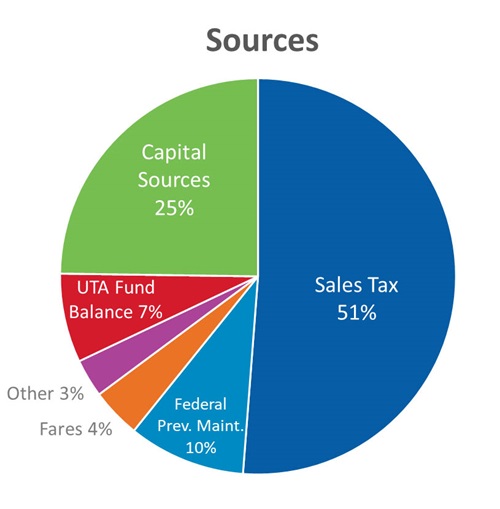
* Total UTA Fund Balance use in 2026 is $73 million.
What is UTA's Investment Strategy?

UTA implements a long-term financial strategy dedicated to responsible, accountable stewardship of public funds. This strategy helps guide the UTA 30-year vision for transit service, which includes replacement and repair of infrastructure.
The annual UTA budget responds strategically to changing needs and emerging demand. UTA’s approach to transit investment allocates funds in the most strategic, efficient manner possible, recognizing the growing demand for transit service exceeds resources available.
How are Sales Taxes Invested in Transit?
Local sales tax revenue makes up just over half of UTA funding. The 6 counties in UTA’s service area have sales tax rates ranging from 6.65% to 7.25% (with a 7.75% rate in Salt Lake City). By state law, each municipality may allocate a percentage of sales tax for transportation purposes, including transit costs.
In the table* below, the blue highlighted cells show the maximum percentage the county may opt to allocate to UTA. The yellow highlighted column shows the actual percentage of sales tax revenue UTA received from each county in 2024.
UTA invests local sales tax revenue to fund local service goals, including infrastructure maintenance to support these goals.
Click table to enlarge
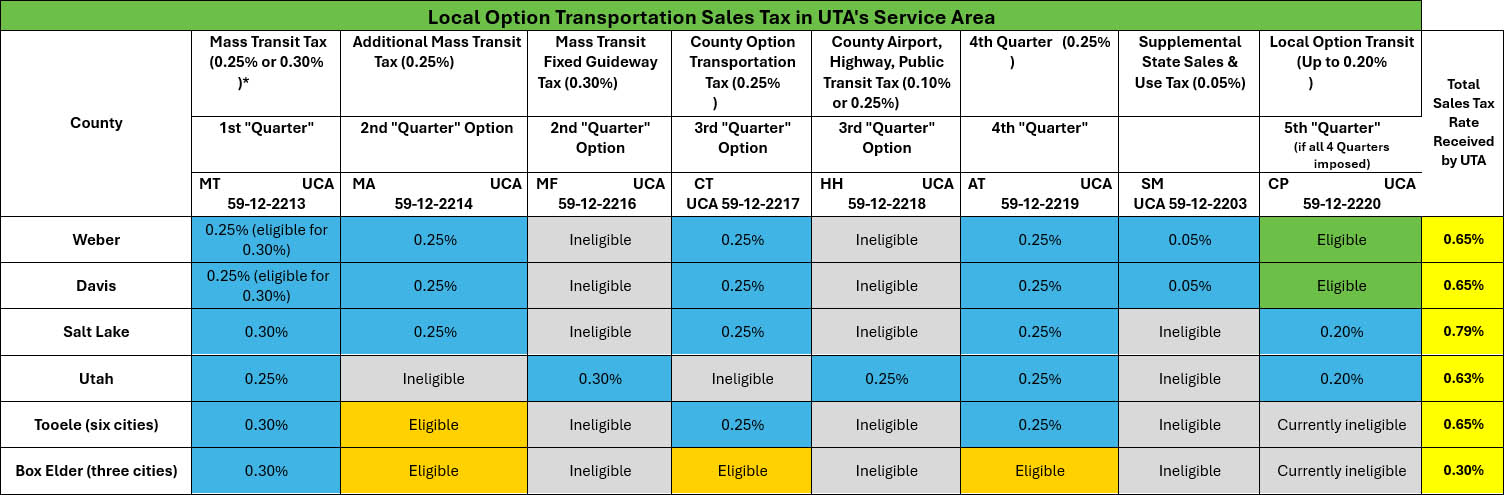
* Table current as of December 2025
What are Capital Sources of Funding?
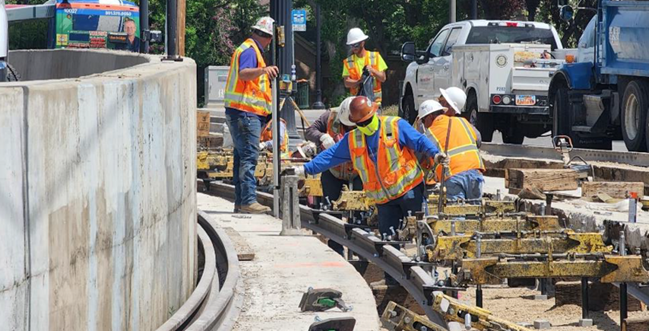
Approximately one fourth of UTA funding is dedicated to capital costs. These costs include vehicles, rail and bus system expansion, and repair or replacement of transit infrastructure.
Sources of funding for capital costs include grants, leasing, bonds, and contributions from the state and from local partners.
What is the UTA Fund Balance?
The UTA Fund Balance is accumulated savings, which are accounted for and programmed for use in UTA long-term transit infrastructure projects and for expanding UTA service.
The use of these accumulated funds is included in UTA's long-term financial plan. Capital costs to expand, replace, or repair major assets such as rail, bridges, vehicles, stations, and crossings require a multi-year funding approach.
Why a Federal Preventive Maintenance Funding Source?
The federal government issues preventive maintenance grants to help transit agencies maintain their systems in optimal working order. By applying for and obtaining federal funds for this and other purposes, UTA can do more with state and local funding.
For example, UTA obtains federal grant funding that directly supports local providers of specialized transportation service, such as mobility programs for persons with disabilities. The work of these local providers complements and creates efficiencies for UTA Paratransit and microtransit services.
How do Utah's Metropolitan Planning Organizations Support Transit Investment?
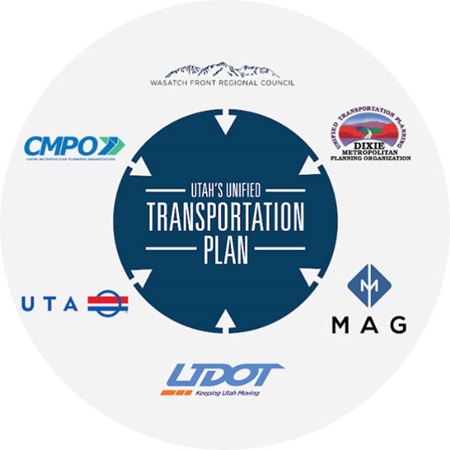
The Wasatch Front Regional Council (WFRC) and Mountainland Association of Governments (MAG) are the regional planning organizations (officially referred to as Metropolitan Planning Organizations, or MPOs) with which UTA partners to obtain transit funding.
WFRC and MAG articulate, in partnership with UTA and UDOT, the multimodal transportation vision for UTA’s service area. The Utah Unified Transportation Plan is a prime example of this vision. For each community they represent, WFRC and MAG evaluate current transit service, forecast demand, identify available funding, and estimate additional funding needed to meet the needs of Utah’s growth. The resulting vision includes potential funding sources. UTA and its partners pursue this funding in alignment with UTA strategic priorities.